

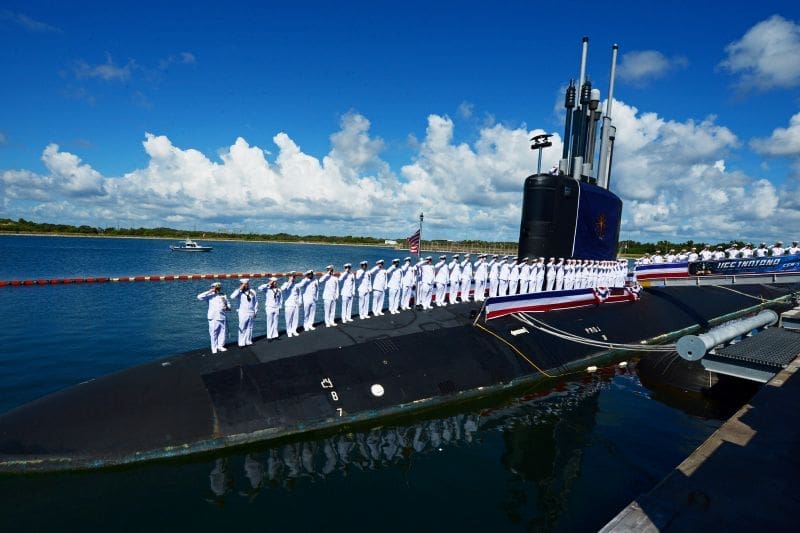
The AUKUS nuclear submarine program is under a Pentagon review to access if the agreement will leave the U.S. Navy with sufficient submarine fleet assets to address its national security requirements. There have been concerns that the current agreement would leave the United States with a shortage of Virginia class boats due to challenges in constructing and maintaining the vessels. As a result, the will now be required to upgrade its Collins-class submarines.
U.S. and U.K. Submarine Industrial Bases
The U.S. Navy currently aims to produce three submarines annually by 2028, including one Columbia-class and two Virginia-class submarines. It is facing delays in these programs, with production rates hovering around 1.1 to 1.2 boats per year. Congress has allocated billions to support submarine production, emphasizing the need to meet both domestic and allied demands.
The U.K. also faces significant challenges, including delays in production and a diminished workforce with the necessary skills. Addressing these issues will require strategic investments, workforce development, and improved management of supply chains to ensure the UK can meet its submarine production goals effectively.
AUKUS Background
The AUKUS agreement is a trilateral security partnership between Australia, the United Kingdom, and the United States that was initiated in 2021. Its initial priority was to facilitate the Royal Australian Navy’s acquisition of U.S.-made Virginia-class submarines. This action was taken in response to China’s threat presence in the Indo-Pacific region in the past decade.
The partnership is also developing a new class of nuclear-powered submarines known as the SSN-AUKUS submarines, with the UK planning to build up to 12 submarines and Australia planning to build five. These attack submarines are expected to enter service in the late 2030s for the UK and early 2040s for Australia, replacing their current submarine classes.
AUKUS and US Export Regulation
The strategic partnership has also involved information sharing, counter-hypersonic technologies, cyber capabilities, artificial intelligence quantum technologies and additional undersea capabilities. AUKUS defense trade rule changes were implemented in 2024 to ease International Traffic in Arms Regulations (ITAR) export policies on these military articles and technologies.
The Bureau of Industry and Security (BIS) which administers the Export Administration Regulations (EAR) had published an interim final rule in April 2024 to remove license requirements for exports, reexports, and in-country transfers for most items between the three countries.
Repercussions for the AUKUS
While defense trade aspects of the arrangement are likely to remain in place the viability of the submarine program remains in doubt. In an appearance before the Senate Arms Services Committee, Adm. Daryl Caudle stated that the U.S. industrial base must grow to a capability of building 2.33 attack submarines per year while maintaining output of Columbia class nuclear ballistic submarines to maintain supplying Australia with submarines.
Caudle endorsed working with international partners for maintenance and repair requirements for U.S. ships. He also stressed minimizing attrition at shipyard to address what amounts to a desired doubling of shipbuilding capabilities.
CVG Strategy Export Compliance Management Programs
The AUKUS Nuclear Submarine program review illustrates the everchanging risks and opportunities for organizations involved in the export of ITAR regulated products. Remaining informed and having an effective export compliance program is essential for maintain a competitive edge.
Export Compliance Management Programs establish clearly defined policies and procedures for all departments within an organization. They ensure that registration, item classifications, license applications, denied part screening, and security measures are taken that will prevent violation. They also ensure that training, auditing, and record keeping are maintained according to requirements.
CVG Strategy can help you understand revisions to ITAR and EAR, and help you establish a coherent and effective export compliance program. We can perform export control classifications, perform audits, assist in filings for export licenses and educate your team. Regardless of whether your business falls under EAR or ITAR, CVG Strategy has the expertise to help.